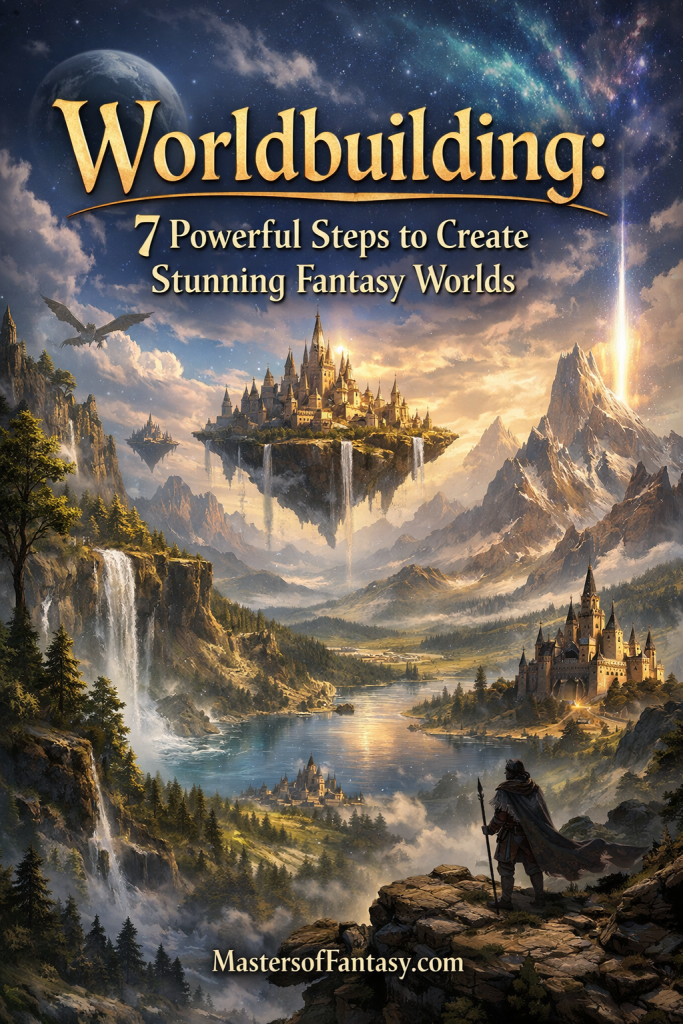
Worldbuilding: 7 Powerful Steps to Create Stunning Fantasy Worlds
Worldbuilding is the single most important skill a fantasy writer can develop. Whether you are drafting your first novel or expanding an existing series, the strength of your fictional universe determines how deeply readers engage with every character, conflict, and plot twist you create. Great stories are built on great settings, and learning to construct them well is more achievable than most beginners assume.
In this guide, you will learn seven practical steps that professional fantasy authors use to construct rich, immersive settings. Each step builds on the last, giving you a repeatable framework for worldbuilding that works across subgenres from epic high fantasy to intimate urban fantasy.
Step 1: Establish the Physical Geography of Your World
Every act of worldbuilding starts with the land itself. Before you name a single kingdom or design a magic system, sketch out the physical environment your characters inhabit. Think about continents, oceans, mountain ranges, rivers, forests, and deserts. Geography shapes culture, trade, warfare, and daily life, so getting the terrain right gives everything else a logical foundation.
You do not need a professional cartographer. A rough hand-drawn map is enough to maintain internal consistency. Mark where resources are abundant and where they are scarce. Decide which regions are fertile and which are barren. These decisions will naturally generate conflict, migration patterns, and economic tension that fuel your narrative.
Step 2: Design a Coherent Magic System Through Worldbuilding
A magic system is often the element readers remember most vividly. Effective world creation demands that your magic has clear rules, costs, and limitations. According to fantasy author Brandon Sanderson, whose lectures on the craft are widely studied, the more clearly you define what magic cannot do, the more satisfying it becomes when characters use it to solve problems.
Decide whether your magic is hard, with explicit rules readers can follow, or soft, where mystery and wonder take priority. Either approach can produce excellent results, but mixing them carelessly often frustrates audiences. Document your magical rules in a reference sheet and check every plot point against them to maintain consistency.
Step 3: Build Cultures and Societies That Feel Authentic
Your worldbuilding truly comes alive when you populate the map with distinct cultures. Each society should have its own values, taboos, art forms, religious beliefs, and power structures. Avoid the common trap of making every civilization a thin reskin of medieval Europe. Draw inspiration from a wide variety of real historical cultures, then remix and reimagine those elements into something original.
Consider how geography influences culture. A desert people will have different clothing, architecture, food, and spiritual practices than a coastal trading nation. Thoughtful worldbuilding connects environment to culture so that every detail feels earned rather than arbitrary. Write short cultural profiles for each major group, covering governance, economy, social hierarchy, and attitudes toward outsiders.
Step 4: Create History and Mythology to Add Depth
A fictional world without a past feels hollow. Readers sense the difference between a setting that existed before page one and one the author invented on the fly. Strong world construction includes wars, treaties, migrations, plagues, golden ages, and dark eras that shaped the current political landscape.
You do not need to write a full history textbook. Focus on the events that directly affect your story and let the rest exist as hints, ruins, and half-remembered legends. Mythology is equally valuable. Creation myths, hero legends, and cautionary tales reveal what a culture fears and admires. When your setting includes layered history, characters can reference the past in ways that make dialogue feel natural and the world feel ancient.
Step 5: Develop Economics and Trade in Your Worldbuilding
Money, resources, and trade routes are among the most overlooked aspects of fantasy fiction, yet they drive many of the conflicts that make stories compelling. Ask yourself what your world’s most valuable resource is and who controls it. Is it a rare metal, a magical substance, fertile farmland, or access to fresh water?
Trade creates alliances and rivalries. A kingdom that depends on imported grain from a hostile neighbor has a built-in source of political tension. Worldbuilding that accounts for economics gives your plot stakes that go beyond personal grudges. Readers may not notice these details consciously, but they will feel the difference between a world where scarcity matters and one where gold appears from nowhere whenever the hero needs it.
Step 6: Use Language and Naming Conventions Effectively
Names carry enormous weight in fantasy fiction. Consistent world creation requires that the names of people, places, and institutions within a single culture share phonetic patterns. If one elvish city is called Thalindor, a neighboring elvish city should sound like it belongs to the same linguistic family rather than switching to an entirely different naming scheme.
You do not need to invent an entire language like Tolkien did. A simple phonetic guide for each culture is enough to maintain coherence. Decide which sounds dominate each culture, establish a few root words, and derive place names from them. This small investment of effort produces a surprisingly large payoff in immersion. Readers will feel the difference between a naming system that was planned and one that was assembled at random.
Step 7: Test Your Setting Through Character Experience
The final and perhaps most critical step in worldbuilding is filtering everything through the lived experience of your characters. A world can have the most detailed magic system, the deepest history, and the most intricate politics, but none of it matters if readers experience it through lifeless exposition dumps.
Show your world through action, dialogue, and sensory detail. Let a merchant complain about tariffs instead of explaining the tax system in narration. Have a soldier flinch at a battlefield monument instead of inserting a history lecture. The best settings feel invisible because they arrive through character behavior rather than author commentary. Every scene should teach the reader something about the world without feeling like a lecture.
Common Worldbuilding Mistakes to Avoid
Even experienced authors stumble during the creative process. One frequent error is over-explaining. Trust your readers to infer cultural norms from context rather than spelling everything out. Another mistake is building a setting so complex that you spend more time on lore documents than on the actual story. Your world should serve narrative, never replace it.
Inconsistency is the third major pitfall. If you establish that magic requires rare crystals, do not let a character cast spells without them three chapters later unless you explain why. Keep a reference bible, a single document that tracks rules, timelines, and facts, and consult it regularly during revisions.
Putting Your Worldbuilding Into Practice
The best way to improve at worldbuilding is to practice deliberately. Start with a single location, perhaps a village or a city district, and build outward. Write a short scene set in that location, focusing on sensory details that communicate culture, climate, and social dynamics without exposition.
Join a writing community where you can share your work and receive feedback. Read widely across the fantasy genre to see how different authors handle these challenges. Study authors like Ursula K. Le Guin, N. K. Jemisin, and Patrick Rothfuss, who each approach the craft from unique angles. The more examples you absorb, the more tools you will have for your own creative work.
Worldbuilding is ultimately an act of empathy. You are imagining how people different from you might live, think, worship, trade, fight, and love in a place that does not exist. When you approach the process with curiosity and rigor, you create worlds readers want to return to long after they finish the final chapter. Start with these seven steps, refine your method with each project, and watch your fantasy worlds grow more vivid and convincing with every story you tell.


