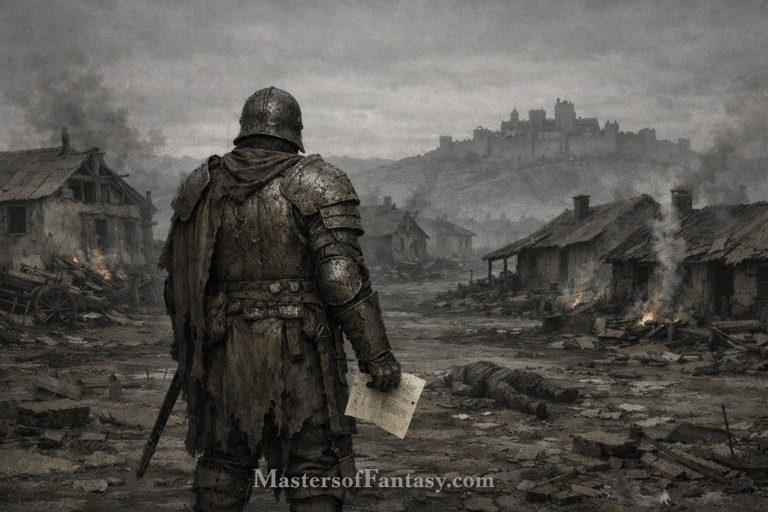
Dark fantasy unsettles you. Grimdark indicts you.
Where dark fantasy builds dread through atmosphere and implication, grimdark confronts you with something harder — a world where the machinery of power is working exactly as designed, and the design is rotten. The horror is not supernatural. It is institutional. It is human. It is recognisable.
Below you will find a 750-word grimdark story written specifically to demonstrate the seven core conventions of the genre in action. Before you read the story, each convention is explained in plain terms. When you reach the story, those conventions are labeled directly in the text so you can see the exact moment each one enters the prose and understand what it is doing and why.
If you have already read our dark fantasy sample, you will notice the difference immediately — in the register of the prose, in the scale of the corruption, and in what the ending refuses to offer. That difference is the point. These are neighbouring genres. But they are not the same genre.
By the time you finish reading, you will be able to tell them apart in your own writing — and place each convention deliberately.
The Seven Conventions You Will See in the Story
1. The Villain Protagonist Not the antihero of dark fantasy, who is morally compromised but retains conscience. The villain protagonist of grimdark is genuinely capable of atrocity — and is aware of this. The reader is not asked to sympathise. They are asked to understand the logic of a person who has stopped drawing lines. That understanding is more disturbing than sympathy would be.
2. Systemic Corruption The defining worldbuilding convention of grimdark. In dark fantasy, corruption tends to be personal — one corrupted healer, one fallen king. In grimdark, the rot is institutional. Every hierarchy, every chain of command, every cause is compromised by design. The system is not failing. It is working exactly as the people at the top intend.
3. Gritty Realism The term used by grimdark writers themselves to describe the unglamorous physical texture of the world. People get sick, go hungry, and react to violence with panic rather than heroism. The world smells. War is not glorious. This realism makes the darkness feel earned — not performed.
4. The Anti-Tolkien Approach Named by literary critic Adam Roberts. Grimdark deliberately dismantles the promises of traditional heroic fantasy: that sacrifice is meaningful, that good causes justify their costs, that the right side wins. In grimdark, the noble cause is always someone else’s project, and the person dying for it is always the last to understand this.
5. Purposeful Brutality The craft distinction between grimdark and shock content. Violence and cruelty in grimdark must reveal something — about power, about the system, about what this world does to the people inside it. Brutality that exists only to signal the genre is the most cited failure in grimdark writing.
6. Hopelessness as a Structural Condition Not a mood. A condition of the world itself. Hope in grimdark is not costly — it is structurally punished. Characters who act on idealism pay for it immediately and completely. This is the line between dark fantasy and grimdark: in dark fantasy, hope exists at great cost. In grimdark, the world has been designed to destroy it.
7. Subverted Heroic Conventions Grimdark takes the furniture of traditional fantasy — the righteous order, the loyal soldier, the honourable commander — and reveals it to be a lie, or a tool, or a machine for producing acceptable losses. These subversions only land if the reader recognises what is being dismantled.
The Story: The Order Comes Down
Read the labels in brackets as you go. Each one marks the moment a convention enters the prose and shows you what it is doing.
The order came down at dawn, same as all the orders. [Systemic Corruption — the casual “same as all the orders” establishes immediately that this is routine; the institution produces these moments regularly; this is not an aberration]
Sergeant Drav read it twice. Then he folded it and put it in his breast pocket, next to the letter from his daughter that he had not answered in three months because he did not know what to say to her anymore. He called his squad together in the grey light behind the mill and read the order aloud without inflection, the way the Captain had taught him, because inflection was how you got questions and questions were how you got problems. [Gritty Realism — the unanswered letter, the technique of reading without inflection — these are the small unglamorous details of a man who has been doing this long enough to have systems for it]
The order was to clear the village.
In military language, clear meant something specific. Drav’s squad knew what it meant. They had done it before, at Fenwick and at the river crossing and at the place no one had named afterward because naming it would have required discussing it. [Anti-Tolkien Approach — the unnamed place exists because the institution has developed a practice of not discussing what it does; heroic fantasy names its battles and honours them; grimdark creates places that cannot be named]
Private Senne raised her hand. She was seventeen and had been in the company four months and still occasionally did this.
“Sir,” she said. “There are children.”
“Yes,” Drav said.
“The order—”
“Covers them.” [Villain Protagonist — Drav does not flinch, does not qualify, does not offer Senne a way to understand this as anything other than what it is; he has stopped drawing lines and no longer pretends otherwise]
He watched her face do the thing faces do when they are deciding what kind of person they are going to be from this moment forward. He remembered his own face doing that, once. He could not remember which village it had been. [Hopelessness as a Structural Condition — Drav cannot remember the moment he crossed his own line; the system has been doing this long enough that the people inside it have lost the specific memory of their own corruption; this is not a man who fell — this is a world that grinds people down until the falling is unremarkable]
They moved out at first light.
The village was small — forty people at most, farming terraced fields on the wrong side of the border that had been redrawn six months ago. They had not moved because no one had told them the border had moved. No one had told them because the order to tell them would have required acknowledging the border had moved, and acknowledging the border had moved would have required explaining why, and that explanation would have reached the wrong ears in the capital. [Systemic Corruption — the reason these people are here, in the path of the order, is entirely administrative; they are not enemies; they are a paperwork problem that has been routed to a military solution because that was easier than a political one]
Drav posted two men at the northern track and sent the rest through the front.
It was over in less time than it took to boil water for tea. He had learned to think in those units. [Purposeful Brutality — the violence is not described; the unit of measurement — tea — is the craft choice; it communicates duration, routine, and the complete domestication of atrocity without a single graphic image; this is purposeful brutality operating through restraint]
After, Senne sat against the mill wall and looked at her hands. She was not crying. People cried in the first weeks. After that they either left or they stopped crying. She had not left. [Hopelessness as a Structural Condition — she has already made the choice Drav made, in less time than it took him; the world does not allow for gradual corruption; it accelerates it]
Drav wrote the report. Forty-three, the report said, because that was what the order required and the order had been based on a census from eighteen months ago and three of the people on the census had died of fever before the company arrived, but forty-three was the number that made the paperwork close cleanly, so forty-three it was. [Subverted Heroic Conventions — the military report, which should be the record of honourable action, is falsified not out of guilt but out of administrative convenience; the institution has no mechanism for truth, only for closure]
He put the report in the pouch.
He did not write to his daughter.
He did not know what to say. [Villain Protagonist / Gritty Realism — the unanswered letter returns; Drav is not without feeling, which makes him more damning than a man without it; he knows what he is and cannot find language for it; the world has made him and the world will keep making more of him]
What to Notice Now That You Have Read It
Go back through the story and find each label. Then ask yourself these questions:
How does this differ from the dark fantasy sample? The dark fantasy story operated through implication, atmosphere, and a single quiet transaction. This story operates through scale, routine, and institutional logic. The violence in the dark fantasy piece was ambiguous. The violence here is administrative.
Where is the villain protagonist’s humanity? Drav is not without feeling — the letter to his daughter appears twice. What does its presence do? What does the fact that he cannot write it tell you about what the system has taken from him?
What is the systemic corruption actually corrupting? Not just Drav. Follow the chain: the border, the census, the order, the report. At no point does any individual make a decision that they would describe as evil. Trace how the system produces the outcome without requiring anyone to be a monster.
What is the story about underneath the story? Grimdark at its best is not about darkness. It is about how institutions metabolise human beings. What is this story actually saying?
Dark fantasy asks what a person becomes in a bad world. Grimdark asks who designs the world that makes them that way — and what it costs the rest of us that we keep living in it.
Now write your own.


