
Read Like a Writer: An Urban Fantasy Story That Shows You Exactly How the Genre Works
Most writing guides tell you what urban fantasy is. This one shows you.
Below you will find a 750-word urban fantasy story written specifically to demonstrate the seven core conventions of the genre in action. Before you read the story, each convention is explained in plain terms. When you reach the story, those conventions are labeled directly in the text so you can see the moment each one appears and understand what it is doing and why.
By the time you finish reading, you will not just understand urban fantasy — you will be able to write it.
The Seven Conventions You Will See in the Story
1. The City as a Character In urban fantasy the city is not backdrop — it is active. It has history, personality, and influence. It shapes the plot, the characters, and the tone. The story could not happen anywhere else. The specific geography, culture, and texture of the setting is part of what the reader is there for.
2. The Hidden World The supernatural world exists parallel to the ordinary world, concealed from most people. The central tension of the genre comes from the collision between these two realities and from the question of who knows, who does not, and what happens when the boundary breaks down.
3. The Protagonist with a Foot in Both Worlds The signature character type of urban fantasy. Someone who belongs to both the mundane world and the supernatural one and is never entirely comfortable in either. Their divided position is not background — it is a source of ongoing tension and the reader’s entry point into the hidden world.
4. The Noir Aesthetic Urban fantasy borrows tone and sensibility from crime noir — dark humour, moral ambiguity, a city that is dangerous and seductive at once, a protagonist who has seen too much to be surprised but not enough to stop caring.
5. The Investigative Plot Structure Something has happened. Something is hidden. The protagonist is trying to find out what. The story moves like a crime investigation — with forward momentum driven by questions rather than action.
6. Magic with Rules and Limits Urban fantasy magic must have defined, consistent limits. The constraints on the magic are not restrictions on creativity — they are the source of the conflict. A character who can do anything faces no genuine threat.
7. The Supernatural as Social Metaphor The best urban fantasy uses its supernatural elements to say something true about the real world. The hidden community, the creature navigating a hostile city, the magic that only certain people can access — these map onto real social tensions and give the story depth beneath its plot.
The Story: What the River Remembers
Read the labels in brackets as you go. Each one marks the moment a convention enters the prose and shows you what it is doing.
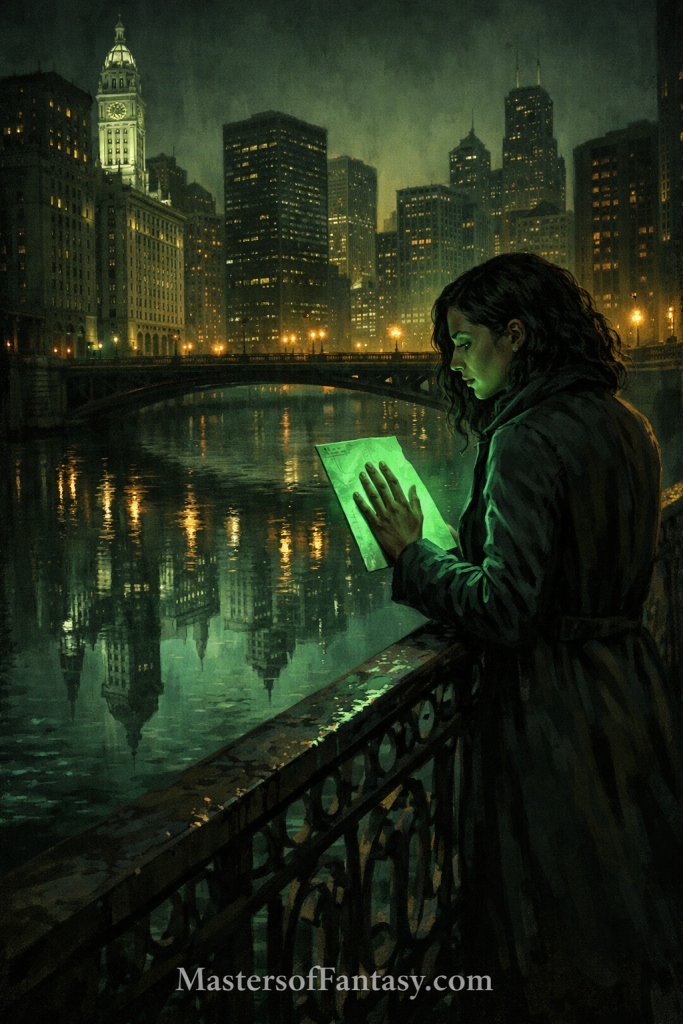
The Chicago River runs backwards. [The City as a Character — this is a real fact about Chicago; engineers reversed the river’s flow in 1900 to protect the city’s drinking water from its own waste. The story opens with a true detail that immediately establishes the city as a place with a strange and specific history — one that will matter]
Most people know this as a feat of engineering. Mara knew it as the reason the water spirits were angry.
She stood on the Adams Street Bridge at two in the morning, looking down at the green-black water, and tried to remember the last time she had slept. Three days ago, maybe. Before the body. [The Investigative Plot Structure — something has happened; the investigation is already in motion before the scene opens; the reader arrives mid-inquiry, not at the beginning]
The dead man had been a courier. That was the official story, and it was even true, as far as it went. He had carried messages between the River Court and the office towers on Michigan Avenue, ferrying paperwork between the things that lived under the water and the firms that had, over the past thirty years, quietly begun to employ them. [The Hidden World — the supernatural world is revealed in a single paragraph: a parallel economy, a River Court, creatures integrated into the city’s professional infrastructure but invisible to most of its population; the hidden world has its own bureaucracy and its own geography]
The unofficial story was that he had carried something he should not have, and that whatever it was, someone had wanted it badly enough to pull him into the river at midnight and hold him there.
Mara worked for neither side. [The Protagonist with a Foot in Both Worlds — this single line establishes her divided position; she is not of the River Court and not entirely of the human city; she exists in the gap between them, which is exactly where urban fantasy protagonists live]
Her mother had been human. Her father had been — well. The river kind did not use the word that humans used. They said deep-blooded, and they said it the way you say a thing that is both a compliment and a warning.
Being deep-blooded meant she could hear the water when it wanted to talk. It also meant she could not get a PI licence in Illinois without lying on three separate forms, and that the River Court considered her too human to trust and the city considered her too strange to hire. She got work anyway. People — both kinds — needed problems solved that they could not take to anyone else. [The Noir Aesthetic — the dry inventory of her professional situation, the bureaucratic obstacles, the unsanctioned work; this is the urban fantasy version of the hard-boiled detective introduction; the humour is in the specificity, not in jokes]
She reached into her jacket and found the folded paper she had taken from the dead man’s apartment. It had writing on it she could almost read — the River Court used a script that shifted depending on how much of you was water. On a good day she could get seventy percent of it. Tonight, in the dark, with the river angry below her and her eyes feeling like sand, she was getting maybe forty.
She pressed her palm flat against the paper. The water in her blood recognised the water in the ink and began, slowly, to translate. [Magic with Rules and Limits — her ability has a visible constraint: it depends on her physical and emotional state, on lighting, on proximity to water; it is not reliable; she cannot simply read the document; the limit is what creates the tension of the scene]
What came through was partial and wrong-edged, the way a conversation sounds through a wall. A name. A number. An address on the South Side that had not existed, according to city records, since 1974.
Chicago was full of addresses that the city had forgotten but the water remembered. [The Supernatural as Social Metaphor — the South Side address, the erasure from city records, the gap between official history and what actually persists; in Chicago this maps directly onto a real history of redlining, urban renewal, and the deliberate disappearance of Black neighbourhoods from official maps; the supernatural memory of the water stands in for the historical memory that the city’s records refuse to hold]
She folded the paper, put it back in her jacket, and looked down at the river one more time.
It looked back.
She walked south.
What to Notice Now That You Have Read It
Go back through the story and find each label. Ask yourself:
- Where exactly did the convention begin — and where did it end?
- What would the story lose if that convention were removed?
- How does each convention interact with the others? The hidden world only works because the city is specific enough to have a real hidden history. The magic’s limits only create tension because the investigative plot has already established what is at stake.
Urban fantasy is not a mood or an aesthetic. It is a set of interlocking craft decisions made at the level of the sentence. Now that you can see them in the text, you can start placing them deliberately in your own.


