Most writing guides tell you what dark fantasy is. This one shows you.
Below you will find a 750-word dark fantasy story written specifically to demonstrate the seven core conventions of the genre in action. Before you read the story, each convention is explained in plain terms. When you reach the story, those conventions are labeled directly in the text so you can see the moment each one appears and understand what it is doing and why.
By the time you finish reading, you will not just understand dark fantasy — you will be able to write it.
The Seven Conventions You Will See in the Story
1. The Antihero Protagonist The antihero is the defining character type of dark fantasy. Unlike the hero of epic or high fantasy — who is fundamentally good and motivated by justice or the common good — the antihero is morally compromised from the start. They may do necessary things for wrong reasons, or wrong things for necessary reasons. The reader cannot fully excuse them, but cannot fully condemn them either. That tension is the point.
2. Black-and-Gray Morality In high fantasy, good and evil are clearly opposed. In dark fantasy, this collapses into black-and-gray morality — a world where the best characters are merely less terrible than the worst. There are no clean hands. No righteous choices. Only degrees of damage.
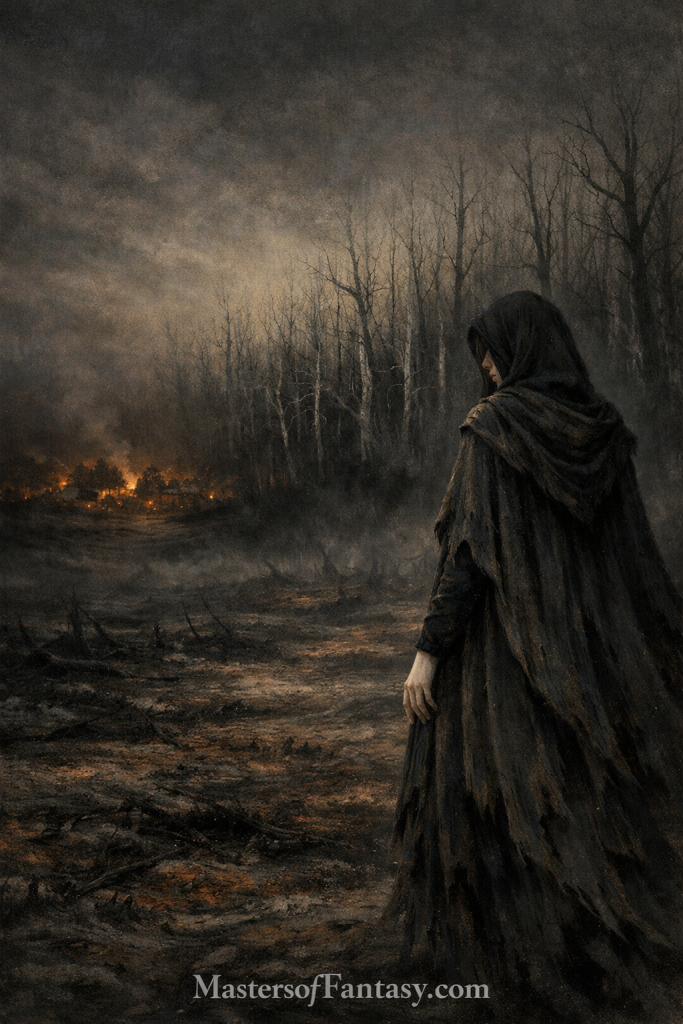
3. Gothic Sensibility Gothic sensibility is the atmospheric foundation of dark fantasy. It refers to the use of decaying, cold, or ruined environments — fog, rot, silence, darkness — not merely as backdrop but as moral communication. The world looks the way it feels. Decay outside mirrors decay within.
4. Forbidden Magic / Magic as a Corrupting Force In dark fantasy, magic is not a gift or a neutral tool. It is dangerous, costly, or morally suspect. Using it extracts something from the person who wields it — sanity, humanity, memory, life. The reader should feel that the character is not simply casting a spell but making a trade they may regret.
5. The Moral Dilemma The moral dilemma is the engine of the dark fantasy plot. It is a choice where every available option carries a serious cost. Unlike a puzzle — which has a correct answer — the moral dilemma has no good outcome. The character must act, and whatever they choose, something real is lost.
6. The Descent Arc Also called the negative arc, the descent arc describes a protagonist who changes for the worse over the course of the story. They may achieve their goal. But they are not the same person who began. What they lose — innocence, restraint, a piece of their humanity — is the true subject of the story.
7. The Unresolved Ending Dark fantasy does not offer the clean resolution of epic fantasy. The ending leaves consequences lingering. Something remains broken. The reader carries the weight of it out of the story. This is not a failure of craft — it is the point. Life in a dark world does not resolve neatly, and neither does the story set inside one.
The Story: What the Healer Kept
Read the labels in brackets as you go. Each one marks the moment a convention enters the prose and shows you what it is doing.
The village called her a healer. [Gothic Sensibility — her title is already ironic; the reader senses something wrong before the story begins]
She had been one, once. Before the fever took the children and the lords took the grain and the river turned the color of old teeth. Before she had walked into the Ashwood alone and come back three days later with clean hands and a cure no one asked about. [Antihero Protagonist — she has already done something morally ambiguous before the story opens; we enter mid-consequence, not mid-innocence]
The village took the cure. They did not take the questions.
Now she sat across from the miller’s wife, who had laid her youngest on the table like an offering. The child’s breathing was the sound of wet paper tearing. Six years old. Maybe seven. The fever was the same fever — of course it was — and the healer felt the familiar pull behind her sternum, that cold hook she had learned not to think about too directly. [Forbidden Magic / Magic as a Corrupting Force — the magic is physically felt as something unpleasant, a hook, not a gift; it pulls at her rather than flowing from her]
“Can you save her,” the miller’s wife said. It was not a question.
The healer looked at the child. Then she looked at her own hands, which were clean in the way that things are clean when they have been cleaned too many times. [Gothic Sensibility — the detail of her hands communicates corruption through physical imagery without stating it directly]
“There is a cost,” the healer said.
“Name it.”
This was the moment she had rehearsed in the Ashwood, in the dark, on her knees in the ash. She had told herself she would explain it honestly. That she would let the mother choose. That she would not simply take. [Moral Dilemma — the setup: the choice is coming, and the reader already senses that both options are bad]
“The thing I use to heal,” the healer said carefully, “does not come from me. It comes from — nearby. From something nearby. It needs to be fed.”
The miller’s wife stared at her.
“What does it eat.”
The healer had many answers to this question. She had spent three days in the Ashwood listening to it explain itself, and it had been very thorough, and she had come home and been sick for a week and then gotten up and begun to practice. She chose the shortest answer now.
“Not the child,” she said.
The miller’s wife closed her eyes. When she opened them, something had shifted behind them — the particular recalibration of a person deciding that what they are about to allow is not what it is. [Black-and-Gray Morality — the mother is not evil; she is a person making a terrible choice for an understandable reason; there are no clean hands in this exchange]
“Do it,” she said.
The healer put her hands on the child’s chest. The cold hook moved. She felt it travel up through her palms and into the small body on the table, and she felt the other thing — the thing in the Ashwood that was not precisely in the Ashwood — lean forward in whatever passed for its attention. [Forbidden Magic / Magic as a Corrupting Force — the magic works, but the entity behind it is actively feeding; the healer is a conduit for something the reader should fear]
The child’s breathing changed. Deepened. Smoothed out like water settling after a stone.
The miller’s wife made a sound the healer did not let herself hear.
She withdrew her hands. They were still clean. They were always clean now. [Descent Arc — this small repeated detail — the clean hands — marks how far she has fallen; she notices it, which means she knows what she has become, which is worse than not knowing]
“What did it take,” the miller’s wife asked. Her voice was different now. Smaller.
“Nothing you will miss immediately,” the healer said. This was true. It was always true. The thing in the Ashwood had excellent taste. It never took anything you missed right away. [Unresolved Ending — the story closes without revealing what was taken, without punishment, without redemption; the cost is real but unnamed; the reader carries the dread forward]
She picked up her bag.
Outside, the village was quiet in the way that villages are quiet when they have decided not to ask.
She walked back toward the Ashwood.
She always did.
What to Notice Now That You Have Read It
Go back through the story and find each label. Ask yourself:
- Where exactly did the convention begin — and where did it end?
- What would the story lose if that convention were removed?
- How does each convention interact with the others? The antihero protagonist only works because of the moral dilemma. The unresolved ending only lands because of the descent arc.
Dark fantasy is not a mood. It is a set of interlocking craft decisions. Now that you can see them in the text, you can start placing them deliberately in your own.


