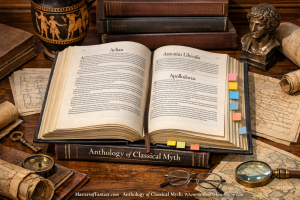
Anthology of Classical Myth: Where to Start When You’re Lost
The Anthology of Classical Myth is sitting on your desk. You opened it, found names you have never heard arranged alphabetically — Aelian, Antonius Liberalis, Apollodorus, Babrius — and quietly closed it again. Your professor assigned readings that jump between authors separated by centuries and genres. You are not sure what you are supposed to be learning, which parts actually matter, or why Apollodorus seems to go on forever while some other author gets half a page. You are not confused about mythology. You are confused about this book, and that is a different problem with a straightforward solution.
What the Anthology of Classical Myth Actually Is
Most mythology courses assign a single textbook that retells the stories for you — Edith Hamilton, Barry Powell, something like that. The Anthology of Classical Myth, edited by Trzaskoma, Smith, and Brunet, does something different. It gives you the ancient authors themselves, translated. Instead of a modern scholar summarising what Hesiod said about the birth of the gods, you read Hesiod. Instead of a paraphrase of Ovid, you read Ovid. This is what “primary sources” means on the cover, and it is also why the book feels so different from anything else on your reading list.
The alphabetical arrangement by author — which is what makes it feel like a phone directory rather than a book — is actually a feature, not a flaw. It means you can move between authors without the editors telling you what to think first. The short introduction before each author is there to give you just enough context to read what follows. Read those introductions. They are not optional decoration.
The Authors Who Will Appear on Your Exam
Not all 52 authors carry equal weight in a typical mythology course, and your professor knows this. Hesiod’s Theogony is the foundational account of how the gods came to exist — it is the creation story, and it sits at the centre of almost every syllabus. The Homeric Hymns tell you who the individual gods are and what they care about. Apollodorus compiles myths comprehensively, which is why he goes on forever: he is the ancient world’s attempt at a complete mythology in one place, organised by family and story. Ovid is the poet — Latin, later, more interested in transformation and feeling than in genealogy — and his selections read differently from everything else in the anthology.
Pausanias, Hyginus, and Lucian appear frequently in syllabi because they preserve versions of myths that do not exist anywhere else. When your professor assigns a passage from one of them, it is usually because the story it tells is the only surviving ancient account of something important. Pay attention to those moments.
How to Read It Without Drowning
The mistake most students make with the Anthology of Classical Myth is reading it like a novel — front to back, everything at once, waiting for it to cohere. It was not designed to be read that way. It was designed to be read alongside something else: your lectures, your secondary textbook, your professor’s assignments. The way into it is through the thematic index at the back. If your course is covering the Trojan War this week, the thematic index tells you which authors in the anthology address it and exactly where. Use it before you sit down to read, not after.
The genealogical charts and maps at the back are equally underused. Classical myth is dense with names, and the relationships between figures are the logic that holds the stories together. When you cannot keep track of who is related to whom — which is a normal experience, not a personal failure — the genealogies make it spatial and visible. Five minutes with those charts before reading a passage will save you twenty minutes of confusion during it.
What the Near Eastern Appendix Is For
The second edition of the Anthology of Classical Myth added a substantial appendix containing Near Eastern texts — the Babylonian Epic of Gilgamesh, the Enuma Elish, the Hittite Song of Emergence, and others. If your professor assigned these, it is to show you that Greek mythology did not emerge from nowhere. The flood in the Atrahasis precedes and closely resembles flood stories that appear later in Greek sources. The succession of gods in the Hittite texts mirrors Hesiod’s account of Ouranos, Cronos, and Zeus with striking precision. These texts exist in the anthology to make a single argument: the Greeks were in conversation with the older civilisations around them, and their myths carry the marks of that conversation.
If your professor did not assign the appendix, you do not need to read it for this course. But if you ever find yourself genuinely interested in where these stories came from — not just what they are — the appendix is where that question starts to get answered.
The Thing Worth Remembering
The Anthology of Classical Myth is large because the ancient world produced mythology across centuries, genres, languages, and purposes. A myth told by Hesiod in the eighth century BC is not the same as the same myth retold by Ovid seven hundred years later. They are both primary sources, both in this book, and they do not agree — because mythology was never fixed, never canonical in the way a sacred text is canonical. Each author made choices. The anthology exists to show you that.
Once you understand that disagreement between ancient authors is not an error to resolve but a feature to notice, the book stops feeling like a wall of text and starts feeling like what it actually is: a room full of voices, each telling the same stories differently, each worth listening to for what the difference reveals.
Start with Hesiod. Read the short introduction first. Use the thematic index when you are assigned a topic rather than a specific author. And do not feel guilty about Apollodorus — every student who has ever taken this course has felt exactly the same way about Apollodorus.
Hackett Publishing — Anthology of Classical Myth (Second Edition)


