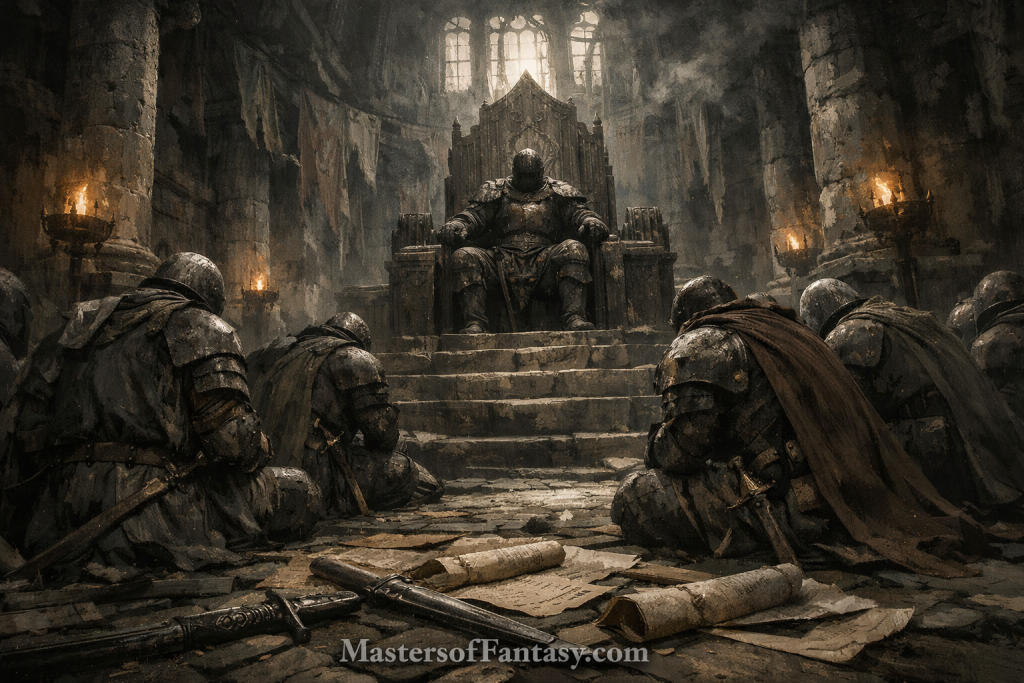
Grimdark is the subgenre of fantasy that refuses to lie to you.
No noble heroes. No righteous causes. No world worth saving in the way Tolkien meant it. Instead, grimdark gives you a world where systems are corrupt, idealism is punished, and the best characters you will encounter are merely less terrible than the worst. It is one of the most demanding subgenres to write — and one of the most rewarding to get right.
This guide covers everything a fantasy writer needs to understand about grimdark: where it came from, what makes it distinct, how its defining conventions work, and how to avoid the mistakes that sink most attempts at the genre.
What Is Grimdark?
Grimdark is a subgenre of fantasy fiction defined by its dystopian settings, morally bankrupt characters, systemic corruption, and the deliberate absence of hope as a structural condition of the world. Unlike dark fantasy — which allows for pockets of light and the possibility of redemption — grimdark presents a world where goodness is not merely threatened but functionally unavailable.
The horrors of grimdark do not primarily come from the supernatural. They come from human nature: from greed, cruelty, political violence, and the machinery of oppression. Magic exists in grimdark worlds, but it does not save anyone. Power exists, but it corrupts everyone who touches it. The question in grimdark is never whether the world can be saved. It is whether survival — moral or physical — is even possible.
Literary critic Adam Roberts described grimdark as fiction “where nobody is honourable and Might is Right” — a world that deliberately trades on the psychology of moral exhaustion rather than moral inspiration.
Where Did the Term Grimdark Come From?
The term grimdark originates directly from the tagline of the 1987 tabletop wargame Warhammer 40,000: “In the grim darkness of the far future, there is only war.”
Initially used as a pejorative — a dismissive label for fantasy fiction that wallowed in bleakness without purpose — writers working in the genre reclaimed it. By the mid-2000s and early 2010s, with the commercial success of Joe Abercrombie’s The First Law trilogy and the global reach of George R.R. Martin’s A Song of Ice and Fire, grimdark had established itself as a legitimate and commercially significant subgenre.
The debate over whether grimdark is a useful term continues in writing communities. Some authors embrace it; others resist it as reductive. What is not in dispute is that the set of conventions it describes — systemic corruption, villain protagonists, subverted heroic expectations — represents a coherent and distinct approach to fantasy storytelling.
Grimdark vs Dark Fantasy: The Critical Difference
This is the question fantasy writers search for most often, and the answer matters for your writing decisions.
Dark fantasy operates in moral grey zones. Its protagonists are morally compromised but not entirely without conscience. Its worlds are threatening and decaying, but pockets of goodness exist. Hope is costly in dark fantasy — but it exists. Redemption is possible, even if it is painful. The darkness is a condition characters must navigate, not an absolute truth about the world.
Grimdark removes that possibility at the structural level. In grimdark, hope is not just costly — it is punished. Characters who act on idealism pay for it immediately and completely. The corruption is not individual but systemic: every institution, every hierarchy, every cause is compromised. As Grimdark Magazine — the leading publication dedicated to the genre — consistently demonstrates through its featured fiction, the genre is defined not by how dark individual characters are but by how thoroughly the world itself has failed.
Think of it this way: in dark fantasy, a good person can exist in a bad world. In grimdark, the world does not allow for good people — only for people who have not yet been fully broken.
The Defining Characteristics of Grimdark
Understanding these characteristics is the foundation of writing grimdark well. Each one is distinct from dark fantasy and must be present for the work to function as the genre.
The Villain Protagonist
Grimdark goes further than the antihero of dark fantasy. The villain protagonist — a named character type in the genre — is genuinely capable of atrocity. Logen Ninefingers in Abercrombie’s The First Law has committed mass slaughter. Jorg Ancrath in Mark Lawrence’s The Broken Empire is a murderer and a tyrant before the story opens. The reader is not asked to excuse these characters. They are asked to understand them — which is far more disturbing.
Systemic Corruption
In grimdark, the rot is institutional, not individual. Rulers, armies, religions, and laws are all complicit. No faction is clean. No cause is just. This is the convention that most sharply separates grimdark from dark fantasy: a single corrupt character can exist in any genre. A world where corruption is the operating system of every institution is specific to grimdark.
Gritty Realism
The term used by grimdark writers themselves — including authors Ed McDonald and Rob J. Hayes in published discussions of the genre. Gritty realism means grounding the fantasy world in unglamorous physical reality. Characters get sick, go hungry, react to violence with panic rather than heroism. The world smells. People are petty and small as well as cruel and grand. This realism makes the darkness feel earned rather than performed.
The Anti-Tolkien Approach
Named directly by literary critic Adam Roberts, this is the defining philosophical stance of grimdark. Tolkien’s fantasy promises that sacrifice is meaningful, that good ultimately triumphs, that the world is worth the cost of saving it. Grimdark systematically refuses these promises. The prophecy is false, or true in a way that destroys the people it was supposed to help. The noble quest reveals itself as someone else’s political project. The warrior who fights for the right cause discovers the cause was not right.
Purposeful Brutality
The single most discussed craft distinction in grimdark writing communities. Violence, cruelty, and suffering in grimdark must serve a thematic purpose — demonstrating the cost of power, the indifference of systems, the absence of justice. Brutality without purpose is the most cited failure mode in the genre. It produces shock content, not grimdark.
Hopelessness as a Structural Condition
Not a mood. Not an atmosphere. A condition of the world itself. This is the line between dark fantasy and grimdark that writers most frequently cross without intending to. If hope exists in your world — even at great cost — you are writing dark fantasy. If hope is structurally unavailable, if the world has been designed so that idealism cannot survive contact with it, you are writing grimdark.
Subverted Heroic Conventions
Grimdark earns its subversions. The chosen one exists — and is a vehicle for someone else’s ambition. The righteous army commits atrocities. The mentor is corrupt. These subversions only land if the reader recognises what is being dismantled. This is why reading widely in epic and high fantasy is essential preparation for writing grimdark — you cannot subvert what you do not understand.
Famous Grimdark Examples Every Writer Should Read
These titles are consistently cited across the genre’s writing communities and critical literature:
- The First Law trilogy by Joe Abercrombie — the benchmark text; systematic dismantling of heroic fantasy conventions with dark humour and precise craft
- The Broken Empire trilogy by Mark Lawrence — features one of the most extreme villain protagonists in the genre; tests the reader’s willingness to follow a genuinely terrible person
- A Song of Ice and Fire by George R.R. Martin — grimdark-adjacent rather than pure grimdark; demonstrates how systemic corruption and subverted heroic conventions work at epic scale
- The Black Company by Glen Cook — the founding text of the soldier’s-eye-view grimdark; no noble causes, only survival and contract
- Malazan Book of the Fallen by Steven Erikson — the most ambitious grimdark worldbuilding in the genre; systemic corruption operating at civilisational scale
How to Write Grimdark Fiction
Establish the System Before the Character
In grimdark, the world is the primary antagonist. Before your protagonist makes a single choice, the reader must understand that the system they inhabit is designed to produce bad outcomes for good intentions. Establish this early — through setting detail, through the behaviour of minor characters, through the gap between what institutions claim to be and what they demonstrably do.
Make Your Villain Protagonist Comprehensible
The villain protagonist does not need to be sympathetic. They need to be legible. The reader must understand the logic of their choices — even choices that are indefensible. Backstory and motivation are the craft tools for this. Not to excuse, but to explain. The most effective grimdark protagonists make a terrible kind of sense.
Apply Gritty Realism Consistently
Gritty realism is not selective. You cannot apply it to violence and then allow your characters to recover from injuries in unrealistic time, eat heroic meals without procurement problems, or form alliances without betrayal. If the world is unglamorous, it must be unglamorous in all its textures — not just the ones that serve dramatic purposes.
Keep Brutality in Service of Theme
Every act of violence, every scene of cruelty, every moment of suffering must answer a simple question: what does this reveal? About power? About the system? About this character’s place in the world? If the answer is nothing beyond the act itself, cut it or rebuild it until it carries meaning.
Resist the Redemption Arc
The single most common failure in attempted grimdark is the writer’s instinct to reach for redemption. Grimdark does not prohibit small human moments — in fact, flickers of connection or decency make the darkness more meaningful. But a full redemption arc transforms your grimdark into dark fantasy. The world must remain structurally hostile to goodness, even if your character briefly touches it.
The Biggest Mistakes Grimdark Writers Make
Darkness without purpose. Gore, cruelty, and suffering that exist to signal the genre rather than serve the story. This is the most common failure and the one most cited by editors and readers.
Confusing grimdark with nihilism. Grimdark is not the belief that nothing matters. It is the demonstration that systems destroy what matters. Characters can care deeply — they simply cannot succeed in the ways that caring would, in a better world, entitle them to succeed.
Protagonist without interiority. A villain protagonist who commits atrocities without an inner life is not grimdark — it is shock content with a fantasy setting. The reader needs access to how the character understands themselves.
Forgetting gritty realism when it is inconvenient. Applying the unglamorous texture of the world only in dramatic scenes undermines the reader’s trust in the world’s consistency.
Redemption creep. Allowing small moments of decency to accumulate into a de facto redemption arc that the genre cannot support.
Is Grimdark Right for Your Story?
Grimdark is right for your story if:
- You want to interrogate systems of power rather than tell a story about individuals overcoming them
- You are prepared to follow a protagonist whose choices you find genuinely reprehensible
- You can commit to a world where hope is structurally unavailable — not just difficult
- You understand the difference between purposeful brutality and gratuitous violence and can apply that distinction consistently
It is not the right fit if you need your protagonist to be redeemable, if you believe the world of your story should ultimately offer justice, or if your instinct is to reward good intentions even partially.
Grimdark is not for every writer. But for the right story, in the right hands, it is one of the most honest things fantasy can do — a mirror held up not to magic and wonder, but to the machinery of how power actually works.
Related reading: [What Is Dark Fantasy?] | [Dark Fantasy vs Grimdark: Where Is the Line?] | [How to Write a Villain Protagonist]


