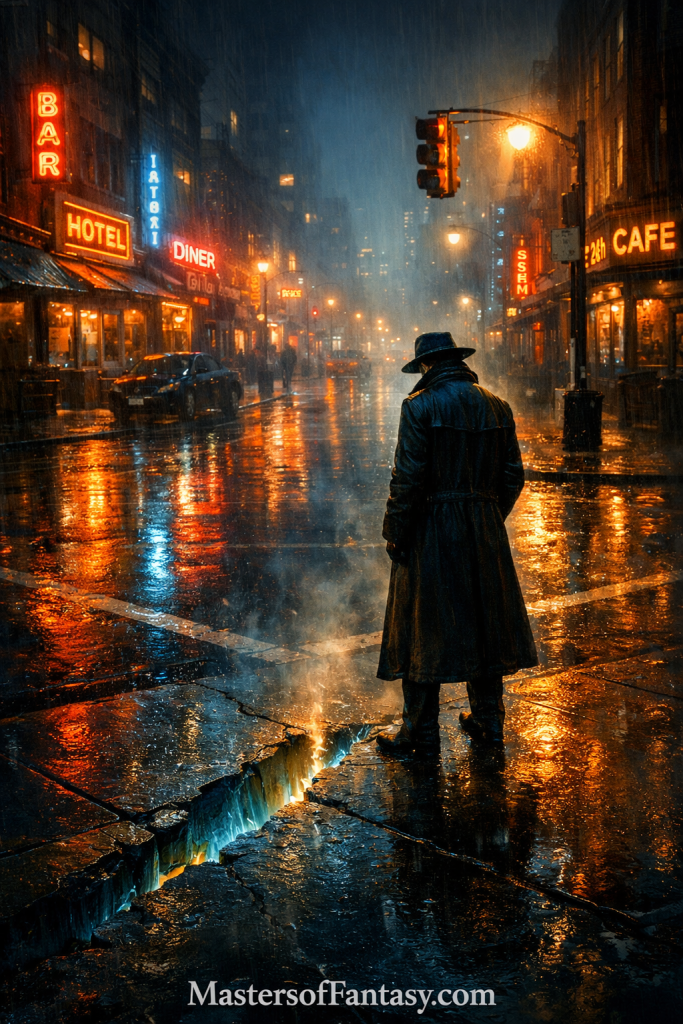
You have read it. You have watched it. You recognised it before anyone told you its name.
The wizard detective working cases the police cannot explain. The vampire navigating a city that does not know he exists. The woman who discovers that the neighbourhood she has lived in her whole life has been hiding something ancient underneath its streets. That is urban fantasy — and if it is the kind of story that keeps pulling you back as a reader, there is a very good chance it is the kind of story you should be writing.
This article breaks down exactly what the genre demands from writers, the conventions readers expect, and the most common places writers go wrong. By the time you finish, you will have the framework to start building your own urban fantasy from the ground up.
What Urban Fantasy Actually Is
Urban fantasy is a subgenre of fantasy in which magical elements, supernatural creatures, and fantastical events exist within a contemporary, real-world setting — most commonly a city. Unlike high fantasy or epic fantasy, which build entirely new worlds, urban fantasy places its magic inside the world readers already know and navigate every day.
The defining tension of the genre is the collision between the familiar and the impossible. A coffee shop where the barista is a witch. A subway system with a parallel line that only the dead can board. A city skyline that looks exactly like the one outside your window — except that something old and dangerous lives in the building on the corner.
That collision is what urban fantasy does that no other subgenre can replicate. It does not ask readers to leave their world. It asks them to look at their world differently.
Urban Fantasy vs Paranormal Romance: The Distinction That Matters
These two subgenres are frequently confused and frequently shelved together, but they are not the same thing.
Paranormal romance places a romantic relationship at the centre of the story. The supernatural elements — vampires, werewolves, shifters, fae — exist primarily to create the conditions for that romance. The central question is whether the protagonists will end up together.
Urban fantasy places the plot — typically an investigation, a conflict, or a threat — at the centre. Romance may exist as a subplot, but it does not drive the narrative. The central question is whether the protagonist will survive, solve the case, or stop whatever is about to destroy the city.
The distinction matters practically: they appeal to overlapping but distinct readers, they sit in different categories on Amazon and in bookstores, and they require different structural decisions from the writer.
Urban Fantasy vs Magical Realism: A Line Writers Must Not Cross
This is a distinction that catches writers off guard, but it is one the genre absolutely depends on.
In magical realism — the tradition associated with Gabriel García Márquez and Isabel Allende — magic exists openly alongside reality. It is accepted, unremarkable, woven into the fabric of ordinary life. Nobody is particularly surprised by it.
In urban fantasy, the supernatural world is hidden. It operates beneath the surface of the ordinary world, invisible to most people. The discovery of that hidden world — or the protagonist’s navigation between both worlds — is central to the story’s energy. As the Science Fiction and Fantasy Writers of America outline in their genre resources, speculative fiction derives its power from the tension between what is known and what is revealed.
If your magic is openly accepted and unremarkable to everyone in your story, you are writing magical realism. If it is hidden, dangerous, and known only to certain people, you are writing urban fantasy. The line matters.
The Seven Conventions of Urban Fantasy
These are not rules. They are the conventions the genre has established over decades of popular fiction — the things readers arrive expecting. Understanding them gives you the freedom to use them deliberately, subvert them intentionally, or combine them in ways that feel fresh.
The city as a character
In urban fantasy, the city is not backdrop. It is active. It has history, personality, and influence. It shapes the plot, the characters, and the tone. The story could not happen anywhere else. The specific geography, culture, and texture of the setting is part of what the reader is there for.
The hidden world
Also called the secret underlayer or the masquerade — the supernatural world exists parallel to the ordinary world, concealed from most people. The central tension of the genre comes from the collision between these two realities and from the question of who knows, who does not, and what happens when the boundary breaks down.
The protagonist with a foot in both worlds
The signature character type of urban fantasy. This is someone who belongs to both the mundane world and the supernatural one and is never entirely comfortable in either. They are the reader’s entry point into the hidden world — and their divided loyalty is a source of ongoing tension.
The noir aesthetic
Urban fantasy and crime noir are natural partners. The genre borrows tone, structure, and sensibility from noir and gritty police procedurals — dark humour, moral ambiguity, a city that is dangerous and seductive at once, a protagonist who has seen too much to be surprised but not enough to stop caring.
The investigative plot structure
Closely tied to the noir aesthetic, the investigative or whodunit plot is a defining structural feature of the genre. Magic and mystery move together. Something has happened, something is wrong, something is hidden — and the protagonist has to find out what. This is what gives urban fantasy its forward momentum.
Magic with rules and limits
Urban fantasy magic must have defined, consistent limits. This is not optional. Because the story is set in the real world, the magic must follow internal logic or the story’s credibility collapses. A character cannot be unlimited in their abilities — the moment they are, the conflict disappears. The constraints on the magic are what create the stakes.
The supernatural as social metaphor
The best urban fantasy uses its supernatural elements to say something true about the real world. Hidden magical communities stand in for marginalised groups. Monster hierarchies reflect class structures. Discrimination against supernatural beings maps onto real-world prejudice. This is what gives the genre depth beneath its plot — and it is what separates urban fantasy that lasts from urban fantasy that entertains once and is forgotten.
Famous Urban Fantasy Examples Worth Studying
Reading widely in the genre is not optional — it is research. These titles represent the range and craft of what urban fantasy can do:
- The Dresden Files by Jim Butcher — the defining example of the noir aesthetic and investigative plot structure in modern urban fantasy; Harry Dresden is the blueprint for the protagonist with a foot in both worlds
- American Gods by Neil Gaiman — the supernatural as social metaphor taken to its logical extreme; old gods surviving in a modern America that has forgotten them
- Neverwhere by Neil Gaiman — London Below as the hidden world made literal; the city as character in its most fully realised form
- Rivers of London by Ben Aaronovitch — a police procedural urban fantasy that handles the magic-with-rules convention with exceptional rigour
- Midnight Riot / Moon Over Soho series — demonstrates how the investigative plot and the city as character can drive an entire long-running series
- N.K. Jemisin’s The City We Became — a recent example of the supernatural as social metaphor at its most ambitious, with the city of New York itself becoming the protagonist
How to Write Urban Fantasy
Choose your city with intention
The city you choose — or invent — is one of your most important creative decisions. It brings its own history, culture, geography, and associations. A story set in New Orleans carries different weight than one set in Tokyo or Lagos. If you choose a real city, know it well enough to use it honestly. If you invent one, build it with the same specificity a real city would demand.
Design your hidden world before you write
Before you write a single scene, know the rules of your supernatural world. What exists in it? How is it organised? What are its laws? How does it stay hidden? How long has it been hidden? What happens when ordinary people stumble into it? The answers to these questions are not background material to be revealed gradually — they are the architecture your plot will rest on. Build them first.
Establish your magic’s limits early and hold to them
Decide what your magic cannot do and make those limits clear to the reader early. Then never violate them. The moment magic becomes a solution to every problem, the story loses its stakes. The limits are not restrictions on your creativity — they are the source of your conflict.
Use the city as a plot device, not just a setting
The best urban fantasy finds ways to make the city itself generate plot. A neighbourhood undergoing gentrification becomes a battleground between old magic and new money. A blackout creates cover for something supernatural. A city’s history — its violence, its immigration, its transformation over time — becomes the context in which the supernatural threat makes sense. Ask not just where your story is set, but what the city is doing to your story.
Ground your protagonist in ordinary life before you introduce the extraordinary
One of the great strengths of urban fantasy is the contrast between mundane daily life and supernatural threat. That contrast only works if the ordinary life is established first. Let the reader see your protagonist dealing with rent, traffic, a broken relationship, a difficult job — before the hidden world breaks through. The more real the ordinary is, the more impact the extraordinary has.
Common Mistakes Urban Fantasy Writers Make
Treating the city as backdrop. Naming your city is not the same as making it a character. If the story could happen in any city without changing, the genre convention is not being met.
Building a hidden world with no internal logic. If the rules of your supernatural world are inconsistent or convenient, readers feel it immediately. Urban fantasy readers are sophisticated — they will notice.
Writing paranormal romance and calling it urban fantasy. If the romance is the point of the story, be honest about the genre you are writing. There is nothing wrong with paranormal romance — but mislabelling the genre misleads readers and agents.
Unlimited protagonists. A character who can do anything faces no genuine threat. Establish limits and enforce them.
Using the supernatural without using the metaphor. Vampires who are just vampires, werewolves who are just werewolves — these miss the genre’s deeper potential. The supernatural elements should mean something beyond their literal existence.
Is Urban Fantasy Right for Your Story?
Urban fantasy is right for your story if:
- You are drawn to contemporary settings and want to bring magic into the world readers already inhabit
- You love crime fiction, detective stories, and investigative plots as much as you love fantasy
- You want your supernatural elements to carry social or political weight
- You are interested in characters who live between two worlds and belong fully to neither
It may not be the right fit if you want to build an entirely new world from scratch, if you find the constraints of a contemporary real-world setting limiting, or if your primary interest is in the epic sweep of high fantasy rather than the street-level intimacy of urban life.
Urban fantasy is a genre of proximity — magic close enough to touch, danger close enough to feel, a city you recognise made strange. If that is the story pulling at you, you already know what to write.
Related reading: [What Is Dark Fantasy?] | [How to Write Grimdark] | [Fantasy Tropes: How to Use Them and When to Break Them]


